
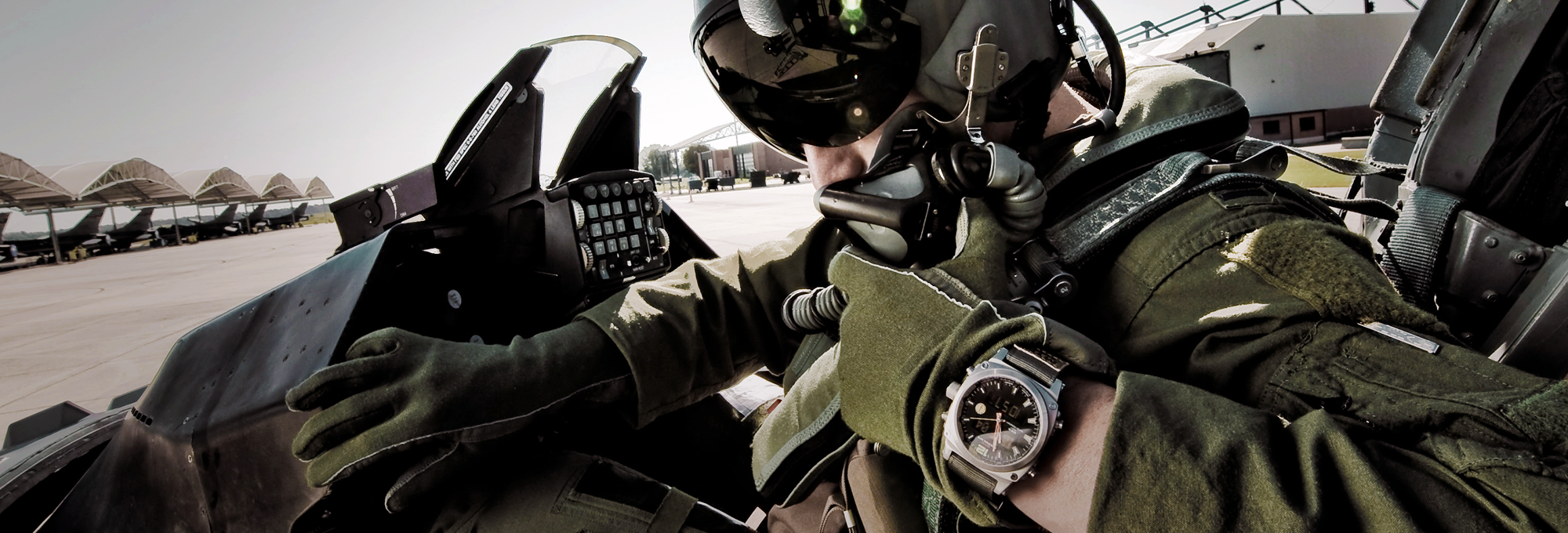
What Watch Does the Military Use?
The US military doesn't issue a watch. Service members buy their own, on their own dime, and the choice depends on the role: a pilot specs differently to an infantryman, who specs differently to a special operator. What unites them is what they look fo - tritium tubes that glow without charging, movements that survive shock and altitude, water resistance suitable for the actual job - and more importantly, a manufacturer that hand-builds and stands beside their product.
We've built military and tactical watches in Los Angeles for 35 years for exactly this customer. Below: why the military doesn't issue a watch, what military personnel actually need from one, and four MTM watches matched to the most common roles.
Why the military doesn't issue a watch
The era of the issued military watch ended decades ago. Vietnam-era field watches were the last time US forces consistently issued a single, standard-spec timepiece across branches. Since then, watches have been treated as personal kit. The military issues your boots, your rifle, your radio. Your watch belongs to you.
There's no procurement contract, no MIL-SPEC document that names a single brand, no "approved list" the way some other countries operate. What there is, instead, is a population of service members buying their own watches based on what they actually need to do their job. In our experience, military buyers consistently choose watches with tritium illumination, sapphire crystals and movements that don't fail at altitude or in salt water. They choose by mission - not because they've been told to buy a specific watch from a specific company.
What military personnel actually need from a watch
Tritium illumination - not Super-Luminova
Tritium gas tubes glow continuously for 25 years without ever being charged. Photoluminescent pigment (Super-LumiNova and equivalents) needs light to charge and fades after a few hours. For night operations, dark interiors, prolonged ops with no light source, and any situation where the watch needs to be readable on demand, tritium is the only real choice. Our tritium-equipped watches use NRC-approved tubes, which means they meet the same federal regulatory standard the US military requires.
Battery life or no battery at all
Service members on extended deployments don't want to think about battery service, which is why solar (rechargeable from any light source) and 10-year batteries are a must-have for servicemen and women. A mechanical automatic might mean you're wearing an incredible watch, but the maintenance requirements mean hassle you don't really need when you're on deployment.
Water resistance for the actual mission
100m for ground forces and air operations. 200m for amphibious work and serious water exposure. Beyond that, you're into commercial dive territory, which only matters for naval and dive specialists. The watches we've featureed here are all rated at 100m or above.
Hand-built, not mass-produced
The differentiator that separates watches military buyers keep from watches they replace. Mass-produced watches at OEM factories ship with batch-level QC and inconsistent fit. Hand-built watches are inspected at the unit level, with gaskets seated by people who know what they're checking. Over a deployment, the difference shows. Every MTM watch is hand-assembled in our Los Angeles workshop, same bench for every tier from entry through flagship.
Our top picks: MTM watches matched to military roles

The Patriot is the watch with the deepest combat track record in our range. One of our customers bought a Patriot from this site before deploying to Afghanistan for OEF 8 in 2007. He took it through a 15-month combat tour. The watch is still running today.
That story sits with us because it's not unusual. Active-duty military, veterans, police officers, and firefighters keep choosing the Patriot, and they keep coming back to tell us how it held up. Featuring classic Special Ops construction: titanium case with Black DLC finish, sapphire crystal, 200m water resistance, full chronograph functionality with a 24-hour military subdial. The watch built for ground forces, by people who supply ground forces.

The Predator II is the tactical chronograph for operators who need precise timing in zero-light conditions. Swiss Ronda chronograph movement with 1/10-second resolution. Tritium tubes on hands and every hour marker, glowing for 25 years without ever needing to be charged.
That matters because tactical timing tasks (interval ops, navigation, briefings, comms windows) often happen in environments where charging the dial isn't an option. Titanium case keeps weight down on long missions. Sapphire crystal handles knocks. 200m water resistance for any environment short of saturation diving. The watch built for operators whose job involves the chronograph button.

The Air Stryk II is built for pilots and aviators. Analog watch on the outside, digital tools underneath. Dual time zones for crossing zones, digital compass for directional reference, stealth mode that blacks out the digital displays during covert activity while the analog hands keep running. LED backlighting for instrument-panel-grade visibility in cockpits.
It also features a countdown timer, alarm, and a chronograph with 10-lap memory. Grade 2 titanium case, sapphire crystal, 100m water resistance. Limited to 500 individually numbered pieces. The hybrid that gives flight crews and aviation operators the digital functionality they need without giving up an analog dial they can read instantly.

The Cobra 44mm is the watch for special operators whose job moves between air, sea, and land. Nautical compass bezel for directional reference. Chronograph movement with 23-hour timing range for sustained ops. Machined titanium case with locking screw-down crown rated to 200m.
One of our customers bought a Cobra in 2018 and has worn it through diving, skydiving, and worldwide travel since. That kind of use case is exactly what the Cobra is built for: a single watch that handles whatever environment the mission moves into.
Why MTM is the watch military buyers choose
We've been hand-building tactical watches in Los Angeles for 35 years. Our customer base, from the start, has been the people who use watches as tools: military personnel across every branch, law enforcement, federal agents, first responders, intelligence community, and the civilians whose lives demand the same standards. We don't have a procurement contract with the US military - we don't need one. What we have is 35 years of selling watches one at a time to people who keep choosing us.
The reason these watches keep coming back from deployments in working order is the build process. The same workshop that builds our flagship pieces (US-744X, Xtreme, Seal) builds every Special Ops model. The same hands, the same QC, the same materials standards. NRC-approved tritium where applicable, which means the federal regulatory body that oversees radiological materials has certified our tritium tubes meet the standard. Every watch ships with a three-year warranty. Most tactical brands at this price tier don't offer that. The reason we can is that we know what we built and we know it's going to last.
Built by hand, in Los Angeles
MTM has been hand-building tactical watches in Los Angeles for over 35 years. Every watch we ship is assembled by skilled craftsmen and women, individually checked, and backed by our three-year warranty. Browse the full Special Ops collection for more options across the range we build for military, law enforcement, and tactical professionals.
Frequently asked questions
The US military doesn't currently issue a single standard watch to service members. The last era of widespread issued watches ended after Vietnam. Today, watches are personal kit bought by individual service members. Different roles favour different watches: pilots, infantry, special operators, and naval personnel all spec differently based on what their job demands.
Special operations personnel choose watches by mission and role rather than by branch. The common requirements are tritium illumination for low-light readability, sapphire crystal for scratch resistance, titanium or 316L stainless steel cases for durability, water resistance appropriate to the environment, and reliable Swiss quartz movements. Several of our customers across special operations branches have worn MTM watches through extended deployments and continue to come back for replacements and additional models.
No. MTM doesn't have a procurement contract with the US military, and we don't claim to be issued. What we have is 35 years of selling watches to military personnel, law enforcement, and tactical professionals who buy our watches with their own money because the watches do the job. The customer testimonials we've received over the years, including from service members deployed in Afghanistan and other operations, are real. We've earned that customer base one watch at a time.
The non-negotiable features are tritium tube illumination (for 25-year glow without charging), sapphire crystal (scratch-proof in normal use), 316L stainless or titanium case construction, locking screw-down crown, and at least 100m of water resistance. Beyond those, role-specific features matter: chronograph for timing operations, GMT or dual time for international deployments, digital compass for navigation, helium release valve for saturation diving. Hand-built construction is the differentiator most listicles ignore but matters most over a deployment.
The categories overlap heavily. A military watch is one designed or specced for use by military personnel, often referencing standard-issue field watches of past eras. A tactical watch is broader: any watch built for active-duty operational use, often with additional features (tritium, larger cases, specialized timing functions). Most modern military watches are also tactical watches. The distinction is mostly historical at this point.
No. The US military doesn't currently provide a watch allowance, and watches aren't included in standard-issue gear. Service members buy their own watches with their own money. This is part of why the question of "what watch does the military use" is more interesting than it sounds: the answer reflects real choices made by people whose lives may depend on the watch working - not what's issued to them.


