
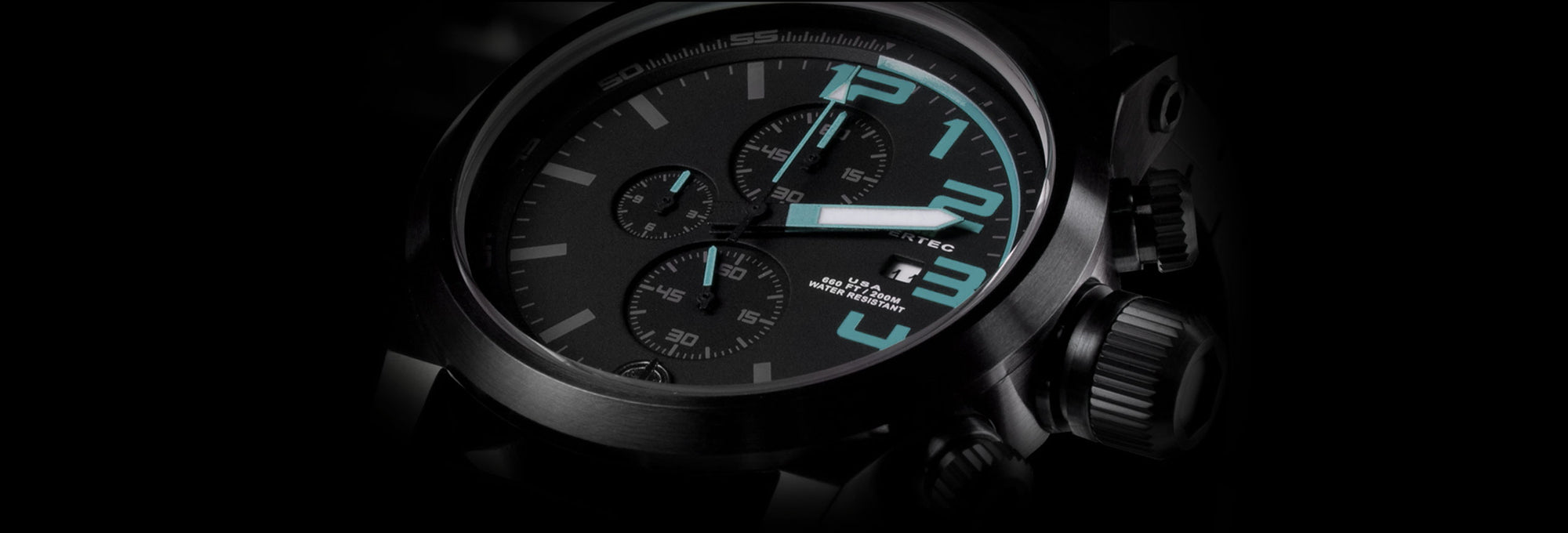
Automatic vs quartz watches
At some point, every serious watch buyer faces this question. You've found a watch you like - or you're about to spend real money for the first time - and someone tells you to think about the movement. Automatic or quartz. It sounds technical. It doesn't need to be.
The movement is the engine inside the watch. It's what makes the hands move, keeps the time, and ultimately determines how the watch behaves on your wrist - how accurate it is, how you maintain it, what it costs, and what it means to own it. Understanding the difference between automatic and quartz doesn't require a watchmaking course. It just requires knowing what you're actually choosing between.
At MTM | WATCH, we build both - handcrafted in Los Angeles by people who take both seriously. This is what you need to know.
What is a quartz watch?
A quartz watch is powered by a battery. That battery sends an electrical current through a small piece of quartz crystal, which vibrates at an extraordinarily consistent frequency - 32,768 times per second. Those crystal vibrations are counted by a circuit, which uses them to regulate time electronically and drive the watch hands. One pulse per second. Every second.
The result is a watch that is ruthlessly accurate. A quality quartz movement loses around half a second per day - which translates to roughly 15 seconds per month. For most purposes, including precision timing in the field, that accuracy is essentially perfect.
Quartz watches have very few moving parts. Fewer parts means less to go wrong. Less to go wrong means more reliability under shock, vibration, extreme temperature, and hard use. Which is exactly why military and tactical operators gravitated toward quartz watches when they became widely available in the 1970s - and why they remain the movement of choice in genuinely demanding operational environments.
What is an automatic watch?
An automatic watch is powered by movement - yours. Inside the case sits a weighted rotor that spins freely as your wrist moves throughout the day. That spinning motion winds a mainspring, which stores mechanical energy. The mainspring releases that energy through a series of gears and springs - the mechanical movement - at a precisely controlled rate, which drives the hands.
No battery. No electronics. A well-made automatic watch is a closed system: wear it regularly and it runs indefinitely, powered entirely by the movement of the person wearing it.
The engineering required to achieve this is considerable. A high-quality automatic movement contains hundreds of components - gears, jewels, a balance wheel, a hairspring - machined to tolerances measured in microns, assembled by hand. The craftsmanship involved is a significant part of what people are buying. When you look at the sweeping continuous motion of an automatic second hand, you're watching that entire system at work. It's why watchmakers have spent centuries perfecting it, and why the best automatic movements carry real heritage - and command the prices they do.
If the watch sits unworn for several days, the mainspring runs down and the watch stops. You reset it, wind it manually or give it a shake, and it runs again. For some owners this is a minor inconvenience. For others, it's part of what they signed up for.
Quartz vs automatic watches - the key differences
Here's the honest comparison:
Accuracy. Quartz wins. Half a second per day versus anywhere from 4 to 25 seconds per day for a well-regulated automatic. If you're synchronizing with other people or timing operations to the second, quartz is the right tool.
Maintenance. A quartz watch needs a battery replacement every few years - typically $10-$20 for a standard battery, more for a lithium cell. An automatic needs periodic servicing, usually every three to five years, to clean and re-lubricate the movement. That service costs significantly more. In exchange, you never need a battery.
Shock resistance. Quartz, with its minimal moving parts, handles impacts better. A good automatic in a quality case is far more robust than most people assume - but it has hundreds more parts to protect.
Longevity. A quality automatic watch, properly serviced, can last 100 years or more. The mechanical parts can be repaired, replaced, and rebuilt almost indefinitely. Both are long-lived if well maintained, but automatic has the edge for true generational longevity.
Price. Quartz movements are less expensive to produce, which means the price of the watch reflects materials, case quality, and features rather than movement complexity. Automatics cost more at every price point - because the movement itself is more expensive to manufacture.
Which should you buy?
Buy a quartz watch if accuracy and reliability are your first priorities. If you work in an environment where your watch needs to be right every time without adjustment - coordinating with others, timing critical tasks, operating across time zones - quartz is the rational choice. It's also the right choice if you want a serious watch that you can wear hard, travel with, beat up, and not think about. A quality quartz will outlast its battery many times over and ask very little of you in return.
Buy an automatic if you want a relationship with your watch. If the idea of something running on your own movement - no battery, no dependence on anything external - appeals to you, then an automatic is more than a timekeeping instrument. It's a piece of engineering that rewards daily wear. People who choose automatics tend to wear one watch, wear it every day, and wear it for decades. They're buying something they intend to pass on. The accuracy tradeoff is real but rarely matters in practice - most automatic owners check the time, not the seconds.
Both are legitimate choices. MTM | WATCH builds both to the same standard - handmade in Los Angeles, designed around what serious watch wearers actually need. The movement is a means to an end. The end is a watch that performs exactly as required, for as long as you own it. Shop our full range of quartz watches and automatic watches below, or browse by brands, collections, and use case to find the right watch for your wrist.
The best quartz watches from MTM
Every MTM | WATCH quartz watch runs a proven Swiss or Japanese movement - accurate, reliable, and built to perform in environments where a watch is not optional equipment.

The H-61 is the entry point into the MTM | WATCH quartz range, and a watch that earns its place without apology. It runs a Swiss Ronda 505 movement in a solid 316L stainless steel case - lightweight, straightforward, and built to take daily punishment from people who wear a watch because they need one, not because they want to think about it.

The Patriot has been worn on active military deployments - including multiple tours of Afghanistan - and come back working. That's not a marketing claim, it's the outcome of a selection process that eliminates anything that can't perform when failure isn't an option, and it's the standard every MTM | WATCH watch is built to meet. See the full chronograph watch range if split-second timing is what you need.

The Predator II was built because combat personnel asked for it - a rugged, water-resistant military chronograph that could take the field and come back working. It's what a tactical quartz watch looks like when it's designed from the wrist up rather than the marketing brief down, by people who understand the difference between a watch that looks tactical and one that actually is. Browse the full tritium watch range if constant passive illumination is a priority for you.

The Cobra 47mm is built for those who want full operational specification and maximum presence on the wrist - a 47mm titanium case with a Swiss Ronda chronograph movement, luminous hands, and 200m water resistance that performs in every environment you can put it in. It makes a statement without giving up any of the specification that makes an MTM | WATCH watch worth owning.
The best automatic watches from MTM
Why buy a mechanical automatic watch?
MTM | WATCH's automatic watches are built for owners who understand what they're investing in - movements that will outlast them, in titanium cases engineered to protect those movements for decades. A mechanical automatic is a long-term commitment. Shop these watches if you're buying for keeps.

The Oconus is MTM | WATCH's entry into automatic watchmaking, and it is not a compromise - a 26-jewel Miyota 9100 movement with a 40-hour power reserve in a Grade 2 titanium case, available in 42mm or 44mm with a top grain leather strap that gives it a character distinctly different from the tactical range. This is a watch you can wear to dinner with the same wrist it came off the mountain on, and it will not look out of place in either setting.

Inspired by the US Navy's Virginia Class attack submarines, the Xtreme is built around a Swiss Sellita SW200-1 - one of the most respected automatic movements in production - in a Grade 5 titanium case with forged carbon fiber and hand-applied tritium gas tubes on every hand and hour marker. It ships with three straps covering every scenario from the boardroom to the field, and it performs equally well in all of them.

The US-744X is built around a Grand Seiko caliber 6R20 - one of the most accurate and durable automatic movements made - in a Grade 5 titanium case with forged carbon fiber, a 5mm sapphire crystal, and 500m water resistance with a helium escape valve for saturation diving. If depth rating is your primary requirement, explore our full range of dive watches. This is not a watch you buy because you need a watch; it is a watch you buy because you understand exactly what you're investing in, and you intend to own it for the rest of your life.
Frequently asked questions
Neither is objectively better - they are built for different things. Quartz is more accurate, lower maintenance, and more shock resistant. Automatic is more mechanically complex, longer-lived, and independent of any battery. The right answer depends on what you ask of a watch. If you need precision timekeeping with minimal upkeep, buy quartz. If you want a mechanical instrument with a lifespan measured in generations, buy automatic.
In most cases, yes - with proper servicing. A quality automatic movement can be disassembled, cleaned, re-lubricated, and rebuilt indefinitely. Mechanical parts can be replicated even when original parts are no longer available. Both last a long time if maintained. Automatic has the theoretical edge for true longevity.
Automatic watches are mechanical watches - the term mechanical simply refers to any watch powered by a physical movement rather than a battery. The distinction within mechanical watches is between automatic and manual wind. A manual wind watch uses the same mainspring and gear-train principle as an automatic, but has no rotor. You wind it yourself, by hand, by turning the crown - typically every day or two. Manual wind watches tend to be thinner and simpler than automatics, and some collectors prefer the daily ritual of winding. For most buyers, automatic is the more practical choice within the mechanical category. At MTM | WATCH, our mechanical watches are automatic.
For several reasons, none of which are irrational. The engineering involved in a quality automatic movement is genuinely impressive - hundreds of hand-assembled components working together with no external power source. Many owners find value in the ritual of wearing a watch that requires their movement to run. Automatic watches also tend to hold and appreciate in value better than quartz. And for buyers who intend to pass a watch to their children, an automatic has more meaningful longevity. Quartz is the more practical choice. Automatic is the more personal one.
That depends on what you value. The price difference between a quartz and automatic watch reflects the cost of the movement - automatic movements are more expensive to design, manufacture, and assemble. If you care about the mechanical engineering, the heritage of the craft, and owning something with a very long service life, the premium is justified. If you primarily need a reliable, accurate watch that requires little thought, a quality quartz delivers more practical value per dollar. Both are legitimate. Only one of them is right for you.


