
Chronograph vs Chronometer: which one should you buy?
Chronograph and chronometer sound almost identical. Both start with chrono - Greek for time. And yet they describe completely different things. One is a function. The other is a certification. Mixing them up is one of the most common mistakes new watch buyers make, and it's not entirely their fault - sometimes the distinction isn't obvious.
What a chronograph watch actually does
A chronograph is essentially a stopwatch built into the watch - but it operates independently from the main timekeeping display. You can start, stop, and reset the elapsed time counter without affecting the time on the dial.
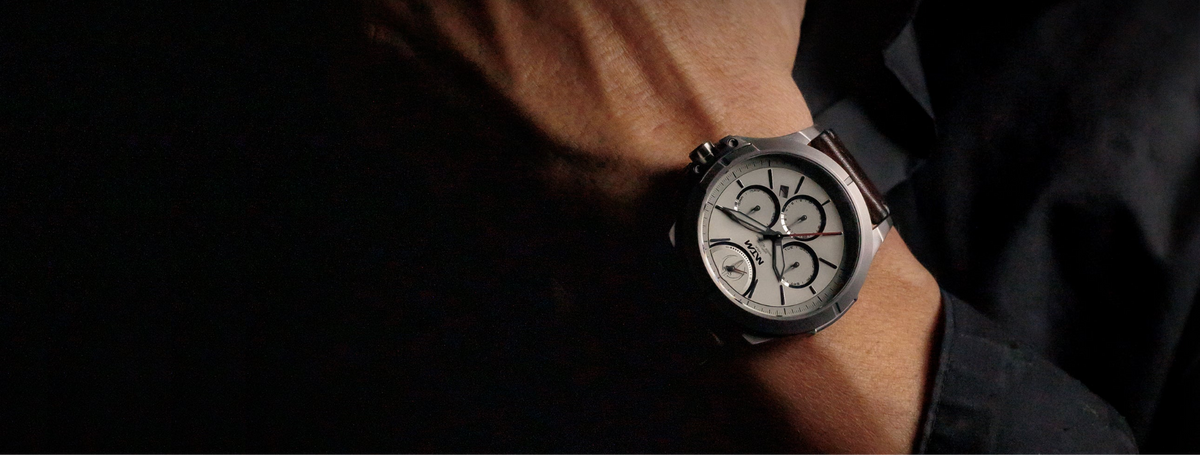
The controls are straightforward: two pushers on the case, usually at 2 and 4 o'clock. The top pusher starts and stops. The bottom pusher resets. Sub-dials track elapsed seconds, minutes, and sometimes hours. In high-stakes environments - cockpits, dive tables, tactical operations - the chronograph function is a mission-critical tool, not an aesthetic choice.
That's the origin of the chronograph, and it still defines its purpose. The chronograph watch was never designed to sit in a display case. It was designed to be used - in the field, at altitude, underwater, under pressure. Everything else is secondary.
Types of chronograph watch
Standard chronograph. The most common configuration. Two pushers, start/stop and reset, with sub-dials displaying elapsed time. The workhorse of the chronograph world - reliable, legible, proven across virtually every environment. Most tactical and pilot chronograph watches use this layout.
Flyback chronograph. A single push of the reset pusher simultaneously stops, resets, and restarts the timer. Developed for aviation, where timing consecutive intervals back-to-back demands speed. Eliminating the stop-reset-start sequence is the point - in a cockpit, that extra fraction of a second matters.
Monopusher chronograph. One pusher cycles through start, stop, and reset in sequence. Simpler case design, more deliberate operation. Reduces the risk of accidental activation in demanding conditions.
Split-seconds chronograph. Also called a rattrapante. Two overlapping chronograph hands run simultaneously. Stop one to capture an intermediate time while the other keeps running - then press again to snap it back. Built for tracking multiple intervals from the same start point.
What makes a watch a chronometer?
A chronometer is a watch that has been independently tested and certified to meet strict accuracy standards. The chronometer does not relate to any function on the dial - a watch with no complications at all can be a chronometer. A chronograph watch is not automatically a chronometer.
The chronometer concept exists because mechanical watches are imprecise by nature. Gravity, temperature, magnetism, lubrication - all of these affect the movement's rate. Chronometer certification is the industry's way of guaranteeing that a specific watch has been tested and meets a measurable standard of accuracy.
What is COSC certification?
COSC - Contrôle Officiel Suisse des Chronomètres - is the primary Swiss chronometer testing body. To earn certified chronometer status, a movement undergoes 15 days of testing across five positions and three temperatures. It must maintain accuracy within -4 to +6 seconds per day. Only around 3% of Swiss watches produced annually pass. If a watch has earned it, the word Chronometer appears on the dial.
Chronometer certification beyond COSC
Some manufacturers operate proprietary testing programmes that go further - testing the fully assembled watch under real-world stress factors including magnetic exposure and power reserve. These represent the highest levels of accuracy standards in watchmaking, held to tolerances tighter than the COSC baseline.
Can one watch be both a chronograph and a chronometer?
Yes. A watch equipped with chronograph functions can also hold certified chronometer status if its movement has passed independent accuracy testing. The two designations are additive - a watch can be one, both, or neither.
Only a small percentage of chronograph watches are also certified chronometers. Earning both requires the movement to pass rigorous independent tests on top of the engineering required to build the stopwatch complication. When a watch carries both, it is among the highest standards a chronograph watch can achieve.
Some of the best chronograph watches from MTM
MTM | WATCH builds chronograph watches for people who need one tool that works everywhere - from a dive to a cockpit to an everyday carry. Here are four of our favorite picks.

MTM's flagship pilot chronograph, built from solid titanium with a classic slide rule bezel and three-register quartz movement. Superior strength and durability in a watch designed for the air, on land, or at sea - and refined enough to wear anywhere else.

A limited edition, individually numbered chronograph built from 316L stainless steel with a sandblasted grey finish. Three bezel options and eleven dial configurations make this the most personalizable watch in the MTM lineup - without sacrificing a single performance specification.

An analog-digital hybrid built for pilots and special operations professionals. The Air Stryk I packs mission-critical tools into a single rugged instrument - including a stealth mode that disables the digital display for covert operations while keeping the analog running. Browse the full range of pilot watches if aviation timing is your priority.

The full Cobra platform in a blacked-out DLC finish. Solid titanium, sapphire crystal, full chronograph function with date window - built to disappear in low light and transition from field use to everyday carry without compromise. See the full chronograph watch range if you want to explore further.
Which one do you actually need?
For most people buying a watch: a chronograph.
Chronometer certification is meaningful - it's a genuine mark of mechanical excellence. But for the majority of buyers, the more useful question is what the watch can actually do. A chronograph gives you a measurable, practical capability on your wrist regardless of where you are.
Buy a chronograph watch if you want a tool watch with real utility - from the cockpit to the training ground to the commute. Buy a certified chronometer if mechanical precision is the point and you're a collector who values accuracy certification as a feature in itself. Buy both if you want the highest standard in every dimension.
MTM builds chronographs. Purpose-built, field-tested, designed to perform in environments that make laboratory certification look straightforward. Browse the full range of chronograph watches and tactical watches to find the right watch for your wrist.
Frequently asked questions
No. A chronograph is a stopwatch complication - a function built into the watch that allows you to measure elapsed time. A chronometer is an accuracy certification awarded after independent testing by a body such as COSC. A chronograph is not automatically a chronometer, and a chronometer does not require a chronograph function. They are separate designations that occasionally appear on the same watch.
Chronograph means the watch has a built-in stopwatch function. The word comes from the Greek chronos (time) and graph (to write or record). On the watch itself, you'll see sub-dials tracking elapsed seconds, minutes, and sometimes hours, controlled by pushers on the case - typically at 2 and 4 o'clock.
Because earning certified chronometer status is genuinely difficult. COSC testing runs 15 days across five positions and three temperatures - the movement must maintain accuracy within -4 to +6 seconds per day throughout. Achieving that consistently requires tighter component tolerances, higher-quality assembly, and more rigorous quality control. Some manufacturers then apply proprietary standards even stricter than COSC, adding cost at every step.
For most buyers, no. Chronometer certification matters most to collectors and enthusiasts who value precision as a feature in its own right. If your priority is a watch that performs in real conditions - timing a dive, tracking training intervals, working in a cockpit - a well-built chronograph is the more practical, more useful answer.
The four main types are: standard chronograph (two pushers, start/stop and reset, the most common layout); flyback chronograph (one press simultaneously stops, resets, and restarts - designed for aviation use); monopusher chronograph (a single pusher that cycles through start, stop, and reset in sequence); and split-seconds or rattrapante chronograph (two overlapping hands that can be stopped independently to capture intermediate times while the other continues running).


