
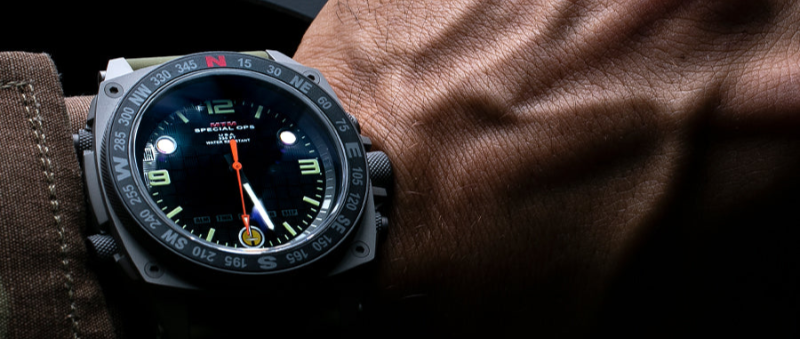
The Best Watches for EMT, EMS and First Responders
As an EMT - you know you don't wear watch to look fancy. A watch is the instrument you use to count a pulse, time a drug, put a number on a patient care report - and any number of other things while you are on shift, saving lives. And what is more - your watch has to work when your phone is buried in a pocket under three layers of PPE.
But what actually matters in the field? What is not going to let you down when you are counting respirations on a stretcher or delivering a life-saving drug to a patient? We have narrowed down our range of EMT watches to the 5 best examples for EMTs and first responders, including what to look for, which watches might be best for different situations and of course, which watches are great for those on a budget.
We have been building military, tactical, law enforcement, firefighter, SAR and of course, EMT watches in Los Angeles for over 40 years. Our watches are not dress watches - they are built for the realities of a 12-hour paramedic shift, where the watch gets caught on a stretcher rail, wiped down with bleach but still has to give you a clean seconds count on the next call.
Why emergency responders need a watch they can rely on
You cannot use your phone as a clock on scene. It is tucked away in your pocket, behind a zip or under a turnout coat. The screen will not work with a gloved finger, and by the time you have dug it out, unlocked it and found the stopwatch, you have lost the count.
A watch solves this simply by just being there. You glance at it, you count, and you are done. No app to find, nothing to unlock, no screen that goes to sleep halfway through a 15-second window. Your watch also has to survive a job that is very hard on equipment. In an ambulance, your watch gets caught on stretcher rails, slammed into door frames, dropped on the tarmac, soaked in fluids and wiped down with chemicals several times during your shift. You might be on a 24-hour or 48-hour shift and your watch needs to be functioning at the end of it. This is why a smartwatch for an EMT can sometimes be a problem - because if you forgot to charge it before your shift, it is useless.
What emergency responders look for in a watch
A seconds display you can read at arm's length
This point separates a nice watch from a useful one on-shift. You are counting a pulse or a respiratory rate, often with the patient's wrist in one hand and your eyes going back and forth. You need a seconds hand that is clearly visible without squinting, and a dial with legible minute markings so you can find your fifteen- and thirty-second points instantly.
Legibility in the dark
A good share of EMS work happens at night, in unlit houses, in the back of a truck with the lights down, or outdoors in weather. Luminous hands get you part of the way. An active light source gets you the rest.
A band you can keep clean
Straps live in the splash zone. Whatever is on your gloves eventually finds its way onto your watch band, and the band needs to survive being wiped down with alcohol or a bleach product without degrading - and without holding onto anything in the weave.
Shock resistance
We do not mean shock resistance as it is described by people trying to market you a "tactical" watch that has no business being named as such. We are talking about the kind of shock resistance that survives a watch case meeting the corner of a stretcher at speed without so much as a blemish.
Water and fluid resistance
You will wash your hands forty times a shift, work in rain, and occasionally get soaked in things you would rather not discuss. 100 meters is sensible. 200 meters is the one you never have to think about again - it will take a fire hose, a decon shower and whatever a patient puts on it.
Battery life that outlasts the shift
A quartz movement with a multi-year battery, or a rechargeable system you top up at home, means the watch is simply always ready. A smartwatch or a phone will want a charger most days - and unfortunately, a watch that you have to remember to charge is a watch that is dead when you did not charge it.
EMT watches that you can use with gloves on
With nitrile gloves on, most watch functions are fine - but small, flush-mounted pushers get fiddly fast, especially when the glove is wet.
Look for buttons with real travel and enough spacing that you are not hitting two at once. A ratcheting bezel is often the better answer: you can grip and turn it with gloves on, in the dark, without looking, and use it to mark a start time without pressing anything at all.
Structural firefighting gloves are a different problem entirely. Nothing small works. If you are on the fire side, a bezel you can turn with a full grip and an illumination button large enough to find by feel are worth more than any number of complications.
The other glove question is illumination. If you need to take your other hand off the patient to light up the dial, the design has failed. One-handed activation - a single button on the case you can find without looking - is what you need.
Cleaning and decontamination
This is where band material is exceptionally important.
The obvious choices here are rubber and silicone straps - they are non-porous, there is nothing to trap fluids and they take alcohol and bleach wipes without degrading or getting damaged.
Nylon and fabric straps are comfortable and light, and they are very popular - but they are woven, which means they absorb whatever they get immersed in. Once something soaks into the weave, wiping the surface does not get rid of it, and while you can clean with chemicals, this shortens their life. If you like a nylon strap off-shift, then you should go with one - but on-shift, a rubber strap is by far the better choice.
Do not use leather - it has no place in this job. It absorbs, it degrades with alcohol and it will not come up clean. Steel bracelets will clean well enough, but they have links and gaps that need attention rather than just a quick wipe-down with bleach.
Whatever you are wearing, you take care of it in the same way - treat the watch as part of the hand hygiene zone, wipe the case and band down when you clean your hands after patient contact, and pay attention to the gap between the strap and the case where the lugs sit. Avoid solvents beyond what the manufacturer allows, and do not submerge a watch you have dropped hard until you are confident the seals and crystal are intact.
Will your department let you wear it?
Most services have something in writing about jewelry and hand hygiene, and a good number have adopted some version of a bare-below-the-elbows policy borrowed from hospital infection control. How that applies to wristwatches out of hospital is contested, but we cannot give you a one-size-fits-all answer here; this is very much based on your department's policy and what they tell you is acceptable vs what is not.
In general terms - a single watch is usually fine. But if it is ostentatious or has anything dangling off it, that probably will not be allowed. If you work in a service with a strict interpretation, or you spend a lot of time inside hospitals, a smaller case on a smooth rubber strap is the best choice - it is easy to clean, easy to push up the arm, and there is nothing to catch.
You should also consider case height - which matters more than case width if you are pushing a sleeve or glove over it, so check this before you buy. And if you are a student, check your program's clinical rotation rules as well as your service's - the hospital's policy will apply to you on your placement.
Our 5 top picks - the best EMT watches from MTM
Best overall - MTM Black Lumi Hypertec H-61, $545

The H-61 is the most straightforwardly wearable watch here, and for most EMTs that is the point. At 42mm it is the smallest case in this list and the easiest to get under a sleeve. It uses a supremely reliable Swiss Ronda 505 movement with a manufacturer-rated four-year battery, so it is as close to fit-and-forget as you will find at this price point, and the sapphire crystal is anti-reflective and scratch resistant - worth having on a watch that spends its life brushing against equipment.
Super-LumiNova hands and indices handle low light, there is a 24-hour GMT hand and a date window, and the dual bezel system gives you something to set with gloves on. 100 meters water resistance with a screw-down crown covers almost everything this job throws at it.
It ships on a black rubber band, which is exactly what you want for patient contact - wipe it down and it is done.
Best for night shifts - MTM Silver Falcon Titanium, $960

The Falcon's whole argument is light. It carries two systems: three white LEDs on the case acting as a torch with an emergency strobe, and five blue LEDs inside lighting the dial from within. Twenty seconds of white light, five of blue. That means you can read your own watch in a pitch-black stairwell without reaching for anything, and you have got a usable hand-torch on your wrist when you need one.
It is built in titanium at 44mm and 4.2oz, so it is much lighter than the size suggests, with a sapphire crystal and 100 meters of water resistance. The proprietary 8J81-M4 quartz movement uses a rechargeable lithium-ion cell rated at ten years - you charge it, you do not replace it.
Best for firefighters - MTM Grey Falcon, $960

Same platform as the Silver Falcon, built for a tougher environment. Military-grade titanium in a sandblasted grey finish that does not throw reflections, sapphire crystal, 100 meters water resistance, and the same twin LED system - white torch and strobe on the outside, blue dial illumination on the inside, with a stealth mode for when you do not want to light yourself up.
The ratcheting bezel is the detail that matters on the fire side: you can turn it with a full glove on to mark a start time, no buttons required. Ten-year rechargeable movement, 4.2oz on the wrist, and it ships in a watertight tactical case.
Best for paramedics - MTM Black Patriot, $1,030

If you are timing things constantly, the Patriot will very quickly become your closest companion. It is a chronograph that uses a Miyota OS-20 movement, with a measuring range of just under an hour - enough for intervals, intervention timing and anything else you need a running clock on - plus a 24-hour military subdial and a date display.
It is the toughest specification in this list: black DLC-coated titanium, sapphire crystal, and 600 feet / 200 meters of water resistance with a locking screw-down crown. It features Super-LumiNova hands and indices and comes with a three-year battery. At 44.5mm and 15mm thick it is a big watch, so check it works under your sleeve or under your glove.
Best on a budget - MTM Grey Hypertec Chrono 2C, $465

One of the most affordable ways into an MTM watch and, in a couple of respects, the most practical watch on this list for day-to-day EMS work. It ships on a grey rubber strap - the right material for this job straight out of the box, no swapping required - and it is rated to 600 feet / 200 meters, matching the Patriot.
The Miyota 0S11 chronograph gives you a running seconds subdial plus a central chronograph seconds hand, which is a very useful combination for counting: start the chrono and you have got a large, unambiguous sweep hand to work from. Sandblasted 316L stainless steel at 44mm, Super-LumiNova hands, two-to-three-year battery, fixed bezel with three customizable options.
One honest note: the Chrono 2C uses anti-reflective K1 tempered glass rather than the sapphire crystal on the pricier models. It is scratch resistant and excellent quality - but it is not as tough as sapphire crystal.
Frequently asked questions
One with a clearly readable seconds display for counting pulse and respirations, enough water resistance to handle constant handwashing and fluid exposure, a band you can wipe down with alcohol or bleach, and a battery that outlasts a long shift without needing a charger.
It depends on the role. Night shift work means that active illumination will earn its place; fire work will benefit from a bezel you can turn with heavy gloves; paramedics doing a lot of interval timing benefit from a chronograph. Across all of them, though, the basics are the same - legibility, a cleanable strap, and reliable power.
Almost always, yes - but policies vary by service, and some have adopted bare-below-the-elbows rules from hospital infection control. A plain watch on a smooth, wipeable strap is the option least likely to cause a problem. Check your own service's policy, and if you are a student, check your clinical placement rules too.
Look for a chronograph or a ratcheting bezel so you can time interventions without doing mental arithmetic, a legible seconds hand, 100 meters of water resistance or better, and a rubber or silicone strap. The MTM Black Patriot and the Hypertec Chrono 2C both cover that brief at different price points.


