
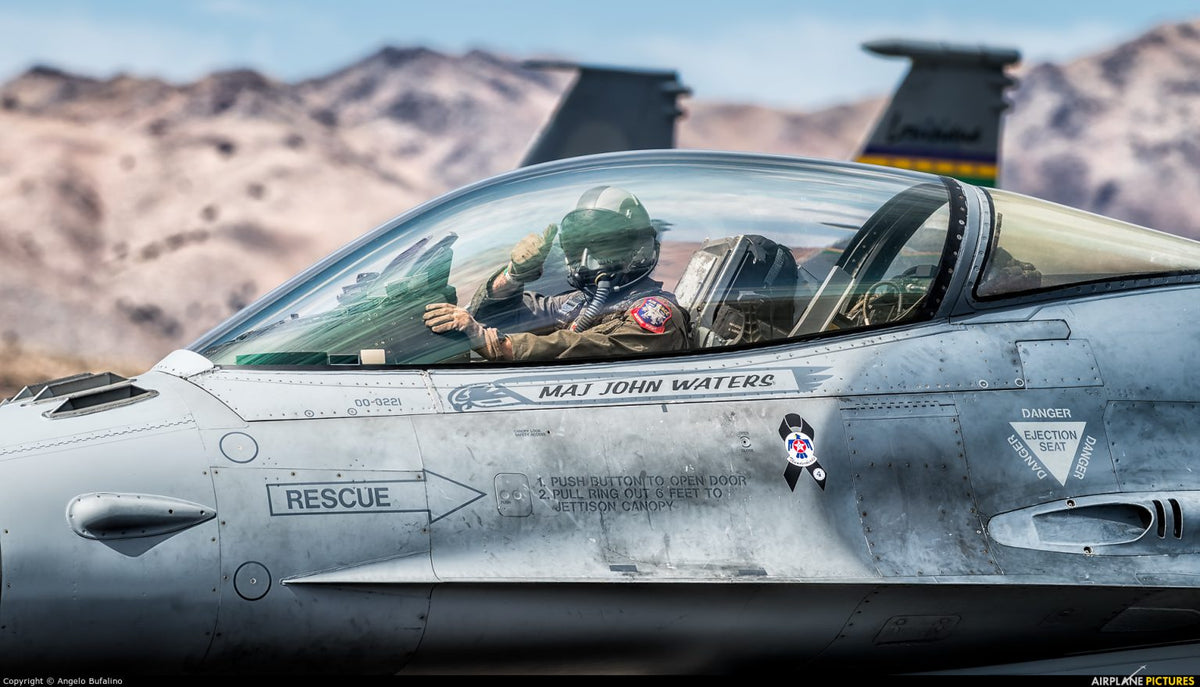
What Makes a True Pilot Watch?
A true pilot watch is a backup instrument. It has to be readable in a split second, keep time you can navigate by, survive the shock and vibration of a cockpit, and work with flight gloves on. Everything else, from the riveted strap to the oversized case worn for effect, is styling.
At MTM we design and build watches that are actually used by military personnel, so we approach the pilot watch with one simple question: what does a military aviator need it to do? In this guide, we run through what a pilot watch is, where it came from, the features that are crucial in the cockpit, the ones that aren't, and the best MTM pilot watches built for the job.
What is a pilot watch?
A pilot watch is a wristwatch designed around the needs of military aviation. Its job is to give an aircrew member the time, elapsed time and, often, a second time zone, instantly and without error, in conditions where looking at a watch for more than a moment is a risk.
Where the pilot watch came from
The pilot watch is a military invention. In the early days of flight, aviators needed to know how long they had been airborne, how much fuel that meant they had used, and when to turn for home. A pocket watch was no use with both hands on the controls.
By the Second World War, air forces were issuing watches to their pilots and navigators built to strict military specifications: large, high-contrast dials, luminous hands, and crowns big enough to wind and set in flight gloves. Every pilot watch made today follows the template that was set by these watches.
Two dial layouts from that period are still widely used. The Type A dial shows large Arabic hour numerals with a triangle at 12 o'clock. The Type B dial puts the minutes on a large outer ring and the hours on a smaller inner ring, because navigators worked in minutes. Both were built for one purpose: reading the time correctly at a glance while flying an aircraft.
MTM | WATCH pilot watches - designed for your toughest mission yet
Every MTM watch is built by hand in Los Angeles and comes with a 3-year warranty.

Digital compass, world time across 58 cities, a chronograph with 10-lap memory and an EL backlight. Priced from $1,300 to $1,525.

The same toolkit as the Air Stryk I (digital compass, world time, chronograph, backlight) in a titanium case weighing 4oz. Priced from $1,450 to $1,800.

Tritium hands and markers that glow without charging, for night flying. Priced from $1,090 to $1,590.

The Cobra's machined titanium build in a more compact 44mm case, for anyone who finds the 47mm too large. It weighs 4oz and is water resistant to 200m. Priced from $1,585 to $2,080.

The largest dial in the range, with a luminous carbon dial and a rotating inner bezel. Priced from $1,520 to $2,080.
What a pilot actually needs from a watch
If you strip away the styling and marketing, there are actually very few things a pilot needs from their watch - but the important thing is that they have to be able to do these things instantly and reliably. Irrespective of whether you fly a 787 or an F-15, these are the things you should be looking for in your next pilot watch.
Instant legibility
In the cockpit, you need to be able to get all the information you need from your watch at a glance - nothing more. That means a high-contrast dial, large numerals or indices, hands that are clearly different from each other, and lume that stays readable through a night sortie. An anti-reflective crystal matters just as much: glare from a canopy or instrument lights can wash out a dial completely.
Lume is where watches differ most. Super-LumiNova needs light to charge and fades through the night, while tritium glows on its own for years. Our tritium vs Super-LumiNova guide explains which works better in the dark - but for a real pilot watch, you'll generally want tritium.
Navigation: time, speed and distance
Before GPS, pilots navigated by dead reckoning: if you know your speed and heading, the time elapsed tells you where you are. Pilots are still trained in it, because it is the fallback when GPS or electronic instruments fail.
Dead reckoning only works if the watch is accurate and easy to time against. A watch that drifts, or a dial you have to squint at, turns a navigation error of seconds into a position error of miles. That is why accuracy has always been a core pilot watch requirement - because it's so crucial for you to be able to work out where you are.
Zulu time: a second time zone
Military aviation runs on Coordinated Universal Time, known as Zulu time. Flight plans, briefings and mission timings are all written in Zulu, wherever in the world the aircraft is based. A pilot needs local time and Zulu time on the same wrist, readable without conversion.
That makes a second time zone a crucial tool on a pilot watch. A GMT hand, a dual time display or a world time function all do the job in different ways. Our guide to GMT vs dual time watches covers the differences.
Tough enough to withstand the flight deck
A cockpit is a hard place for a watch. There is constant vibration, sharp shocks on landing and in turbulence, and in military aircraft, heavy G-forces. Around the instruments and electronics there are magnetic fields, too.
A pilot watch needs a case and movement designed and built to take all of that: a strong case, a sapphire crystal that resists scratches, and a movement that keeps running through shock and vibration. Quartz movements are generally far less affected by magnetism than mechanical ones, which is one reason many working pilot watches use them.
Usable in flight gloves
Flight gloves are thick, and a pilot often can't take them off. Every control on a pilot watch has to work through them: a crown big enough to grip, pushers you can find and press by feel, and a bezel with a grip that doesn't slip. This is where the classic oversized pilot watch crown came from.
Timing tools: chronograph or rotating bezel
Pilots time everything: fuel, legs of a route, holding patterns, approaches. A chronograph does this with a stopwatch function. A rotating bezel does it more simply, by lining up a marker with the minute hand at the start of a leg.
Both are useful, and many pilot watches have both. Just don't confuse a chronograph with a chronometer, which is a certification of accuracy. Our guide to chronograph vs chronometer sets out the difference.
What doesn't make a pilot watch
Plenty of watches sold as pilot watches have the look and none of the function. You might find some of these features in a pilot watch, but they don't make a pilot watch on their own.
- A huge case for its own sake. Size helped legibility on wartime navigator watches. A big case with a cluttered or low-contrast dial just gets in the way and doesn't give you what you need in the cockpit.
- A riveted leather strap. It looks the part, but it's a classic case of form over function.
- A vintage-looking dial. A Type A or Type B dial is only useful if it is legible, luminous and protected by a good crystal.
In a modern cockpit, the instruments do the heavy lifting. The absolute vast majority of pilots in the modern age will never need to use their watch to tell them anything other than the time, because modern instruments are so reliable. But - a true pilot watch is the backup that still works when they don't. That means that every feature of the watch needs to earn its place.
Do military pilots still wear watches?
Yes, and for the same reasons as always. Cockpit displays tell the time, but a watch on the wrist keeps working if power or instruments fail. It keeps Zulu time alongside local time, it times mission segments and fuel, and it goes with the pilot when they leave the aircraft. And - off the aircraft, the watch is the only instrument a pilot still has. That's why military pilots choose watches that are built for the job, and why we build ours to such a high standard.
Pilot watch vs field watch vs dive watch?
All three come from military use, and they overlap, but each is built around a different job.
A pilot watch is built for the cockpit: maximum legibility, timing functions, often a second time zone, and controls that work in gloves.
A field watch is built for ground forces: simple, legible, tough and usually smaller, with a focus on telling the time reliably in any conditions. Our guide to field watches covers them in detail.
A dive watch is built for underwater use: high water resistance, a screw-down crown, and a unidirectional bezel for timing a dive. See our pick of the best dive watches under $1,000.
The easiest way to tell a dive watch from a pilot's watch is the bezel and the priorities. A dive watch is built to keep water out; a pilot watch is built to be read and timed against in the air.
Frequently asked questions
A pilot watch is built to be read instantly and used as a backup cockpit instrument. Its high-contrast luminous dial, accurate timekeeping, timing functions and glove-friendly controls all come from military aviation requirements.
A field watch is built for ground forces: simple, tough and legible. A pilot watch is built for the cockpit, adding timing tools, often a second time zone, and controls designed for flight gloves.
Look at the bezel and the priorities. A dive watch has a unidirectional bezel for timing dives and is built for high water resistance. A pilot watch prioritizes legibility, timing functions and a second time zone.
For military aviation, a second time zone is a working tool, because flight plans and mission timings are written in Zulu time. A GMT hand, a dual time display or a world time function all let a pilot read local and Zulu time together.
Size started as a legibility requirement: wartime navigator watches were very large so they could be read at a glance, often worn over a flight jacket. Large crowns made them usable in gloves. Today a pilot watch only needs to be big enough to stay legible, which is why size alone doesn't make a true pilot watch.


